On-Site Field Tests to Check Cement Quality Instantly
Constructing a house is often one of a person's most significant milestones in life. Each brick, beam, and slab will depend on one Key material: cement. No matter how skilfully the work is performed, if the concrete used is not fresh, or stored appropriately, the resulting construction may experience problems.
Knowing how to check the cement quality will help a home builder to avoid possible structural flaws, save money on repairs, and achieve construction quality that will stand the test of time. Although laboratory methods can provide a thorough analysis, there are a few practical and simple field tests that allow one to perform the cement quality check directly on the construction site. The following guide will show some quick and effective methods that anyone can use for checking the quality of cement before it is mixed into concrete or mortar.
Why Cement Quality Matters?
Cement functions as a binding agent that joins different components of the structure. Defective cement may lead to problems like destruction, weakness, cracks, shrinkage, and water penetration. Checking the quality of cement before the construction process is valuable in identifying potential issues at an early stage.
The inspection process takes only a short time and makes way for saving crucial work hours and finances later.
5 Simple Ways to Verify Cement Quality on Site
Some effective methods for testing cement on site, that can be completed without any sophisticated equipment.
1. Check the Manufacturing Date
The first step in cement testing is to check the date of manufacture as printed on the cement sack. It is imperative to understand that as cement remains stored in warehouses, it deteriorates and loses its strength owing to long durations of static pressure, moisture or aridness in the air, temperature of the storing unit etc. Even when the cement is kept adequately safe, its quality has a tendency to reduce with time.
Quick Check:
Read the manufacturing date on the bag.
Avoid bags that have been stored for an unusually long duration.
Prefer recently manufactured cement for critical structural work.
Fresh cement generally delivers better bonding and strength characteristics.
2. Feel the Texture by Hand
An elementary touch test can tell much about the quality of cement being tested.
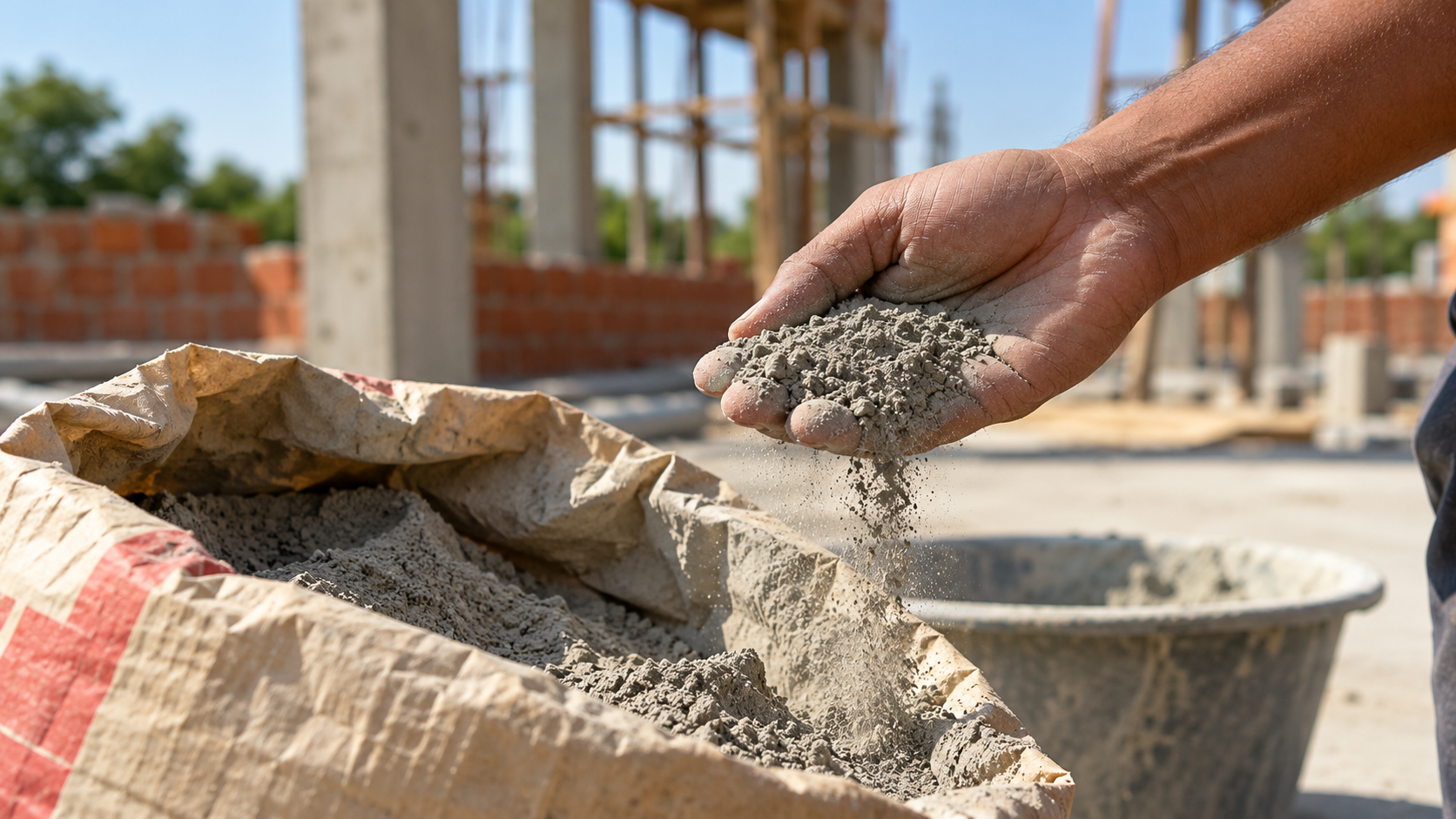
Take a small amount of cement in hand and rub it well between your fingers. A good-quality cement will feel smooth and fine when rubbed like that. If it feels a bit coarse in feel or seems to have some rough particles in it, it may have absorbed moisture and/or gotten partially set.
There are also some things to keep in mind when testing cement:
An apparent smooth and powdery texture indicates that the cement is fresh.
A coarse texture may indicate some kind of contamination or moisture access.
The presence of lumps usually indicates that the cement has deteriorated.
This is one of the simplest methods to check cement freshness before use.
3. Inspect for Lumps
It is very important to inspect and check the bags when you have a considerable quantity of cement stored with you.
The first thing you need to do is to make sure that cement is not spoiled. Cement reacts with moisture in the air. When cement is first exposed to moisture, it starts to hydrate and form lumps. If cement is only slightly hydrated and lumps are minimal, it is fine, but large lumps indicate that cement is spoiled.
Quick Check:
Look for the following signs of cement deterioration:
The bag is not swollen.
Check whether any lumps can be easily broken by hand.
Avoid using cement containing hard, unbreakable lumps.
A clear indication that cement is not suitable for use is the presence of hard lumps. Cement is affected by humidity in the air. It creates hard lumps if the water is found in too great a quantity, thereby making it unsuitable for use as a building material. Checking for the temperature and colour of the cement. Both temperature and colour play an important role in determining whether the cement is of good quality or not.
4. Temperature and Colour Check Protocols
Colour and temperature provide useful clues regarding cement quality.
Colour Check
Good-quality cement generally has a uniform colour. Major colour inconsistencies within the bag might imply that the cement is contaminated or improperly manufactured.
Check for:
Uniform cement colour.
No strange colour changes.
No visible particles.
Temperature Check:
Put your hand in the bag of cement and feel it. New cement should feel cool to the touch. If the cement feels warm, it was probably exposed to moisture and is undergoing chemical processes already.
This simple assessment is an effective component of the testing of cement on site process.
5. The Float Test: A Preliminary Field Check
The float test is one of the easiest tests to conduct for checking whether the cement is contaminated and, for examining its present quality as per its grade.
How to Perform the Test?
The steps for conducting the test are:
Take an empty bucket or container and fill it with water.
Take some cement in your hand.
Sprinkle a small quantity of this cement over the water.
Observe the behaviour of the cement in water.
Expected Result:
Cement of good quality must float on water for some time and then begin to sink. This occurs because newly made cement is made up of very fine particles, which have air bubbles in them and also because of surface tension, which makes the material buoyant temporarily.
Abnormal Behaviour:
Sinking of cement at once into the bottom of water indicates that the cement has become wet and partially hydrated. It can also indicate the presence of heavy impurities in it.
On the other hand, if the cement keeps floating on water for a long time as if it were dust, it indicates that it may be adulterated with some light material. In either case, the cement should be examined further before use.
Important Limitation of the Test:
Although float test is a good preliminary test to determine the freshness of the cement as well as to find out any possibility of contamination in the cement, it cannot help in finding out the chemical composition, compressive strength, and grade of the cement. The cement grades may be Grade 33, Grade 43, or Grade 53 cement, etc. These things can only be found by conducting a laboratory test.
Therefore, the float test should be considered an initial field-level assessment and not a substitute for certified quality testing.
Signposts of Damaged or Expired Cement
There are several indicators that can suggest cement quality has been compromised before the bag has even been opened.
Visible Damage to Packaging
When bags are damaged, moisture or contaminants can enter the bags. Therefore, it is advisable to check all bags for rips, holes, or areas that are wet.
Presence of Moisture in the Bag
If bags are damp or wet, then it is likely that cement is already partly hydrated.
Presence of Hard Lumps
Hard lumps are probably the surest indication that cement has absorbed moisture.
Abnormal Colour Variance
Cement generally has a uniform colour throughout. If you witness different shades in the same portion of the cement, it is likely that cement is of poor quality or has experienced contamination.
Warm Cement Bags
Bags of cement that feel warmer than usual are likely undergoing a reaction caused by moisture exposure.
Builders and individuals alike can use the mentioned methods as they are highly useful in checking cement quality, including inspecting the manufacturing date, feeling the texture, looking for lumps, testing the colour and temperature, and observing the float.
The tests are very simple and not precise; however, they perform essential functions in avoiding the usage of bad cement. Builders can save time and ensure construction reliability and safety by performing such tests on-site.
When it comes to construction quality, starting with fresh, reliable cement is one of the smartest decisions a builder can make. JK Lakshmi Cement’s varied and diverse product portfolio gives every aspiring home builder the cement, which matches his vision.





 Back